
Lunch & Learn: Getting It Right at the Water’s Edge — Practical Insights into OHWM and SDAM
WATCH NOW: ▶️
Webinar Summary: 📝
Practical Tips for OHWM & SDAM Field Work
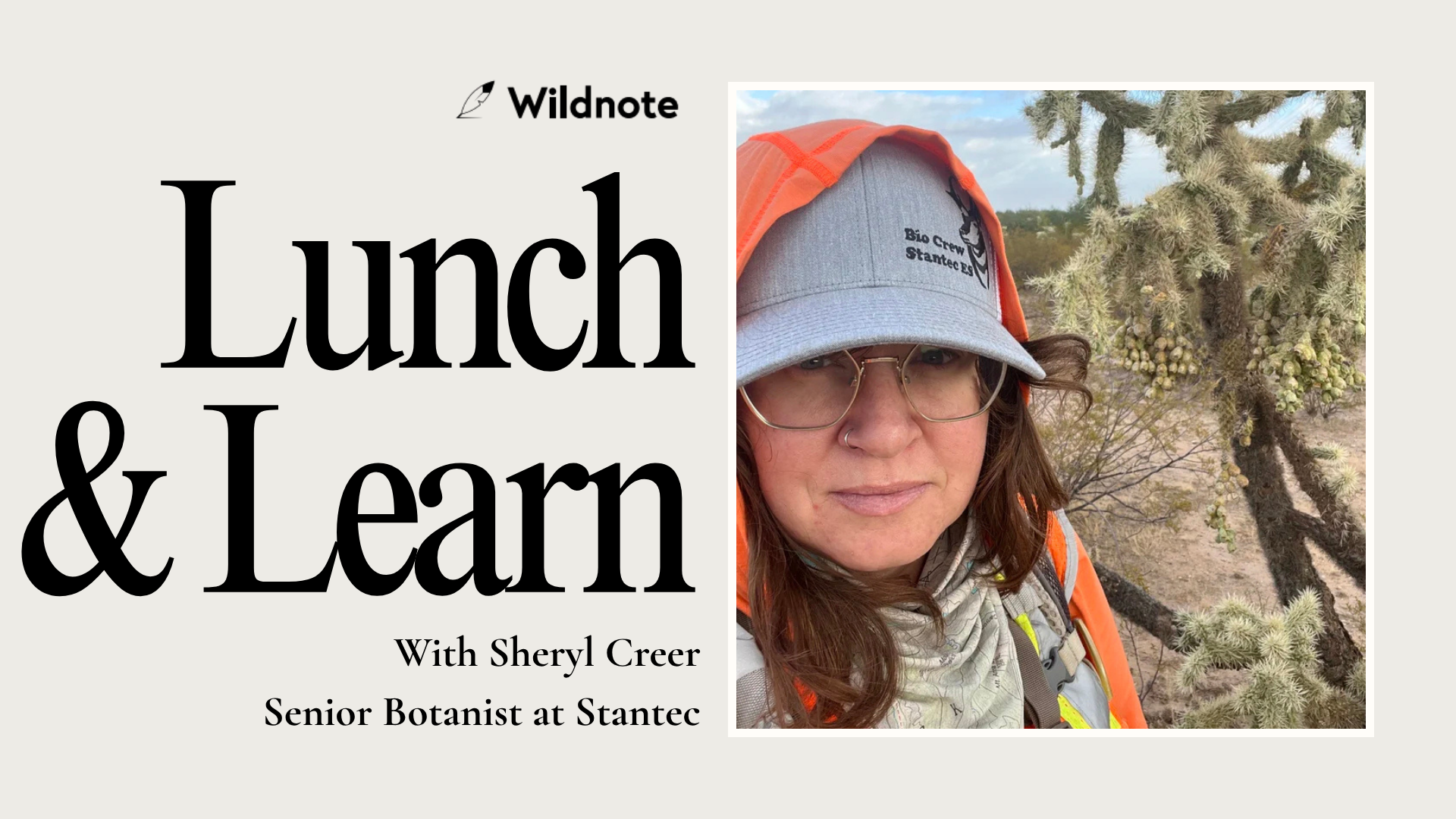
Guest Expert: Cheryl Creer, Senior Botanist & Wetland Specialist, Stantec
Hosted by: Wildnote
Date: December 2025
Overview
This webinar focused on practical, field-driven guidance for performing Ordinary High Water Mark (OHWM) delineations and using the Streamflow Duration Assessment Methods (SDAM) across regions—especially the Arid West and Western Mountains. Cheryl shared real-world examples, time-saving advice, and how new federal regulatory changes may shape future field protocols.
Key Themes & Takeaways
1. The Relationship Between Wetland Delineations, OHWM & SDAM
Modern “wetland delineations” are more accurately aquatic resource delineations.
Field teams must often complete:
A wetland determination form
OHWM form
SDAM
Sometimes additional region-specific tools (e.g., MESA protocol in CA desert solar projects)
OHWM determines where the aquatic resource is; SDAM determines flow regime (perennial, intermittent, ephemeral).
2. Why SDAM Matters More Than Ever
Changes in the definition of Waters of the United States (WOTUS) made ephemeral streams non-jurisdictional.
→ Accurately distinguishing ephemeral vs. intermittent now directly affects federal jurisdiction.
SDAM:
Provides a quantitative, standardized way to determine flow regime.
Reduces back-and-forth with the Army Corps.
Prevents costly rework and delays.
Case Example:
A project without SDAM data received a Corps request for additional information, delaying approval by six weeks. Another project required 75 additional data points—forcing a full extra mobilization.
3. Practical Field Tips for SDAM Pre-Field Planning
Read the manual — this is not a form you can “wing.”
Understand which indicators feed the actual statistical model (R code).
Tools Cheryl Recommends
PocketMacros app – free, photo-based dichotomous key for aquatic invertebrates
Percentage Cover app – inexpensive, accurate alternative to a convex spherical densiometer
Ocular estimation is still acceptable for:
Canopy cover
Streambed slope
Depth measurements
Time-Consuming SDAM Elements
Mapping upstream/downstream boundaries for each assessment reach
Dip-netting and identifying aquatic macroinvertebrates
Measuring canopy with prescribed methods
Detailed vegetation documentation within ½ streambed width
These steps add ~20 minutes per site, based on participant feedback.
Cheryl’s “Streamlined SDAM Approach”
Build a stripped-down version of the form collecting only indicators used by the SDAM model.
Enter results into the web calculator after returning from the field.
Include a strong note: “Do not select flow regime until model results are obtained.”
4. Practical Field Tips for OHWM
National Rapid OHWM Form vs. Regional Forms
The 2024 National Rapid OHWM form is being promoted across districts.
LA District requires it; Sacramento and San Francisco list both national and Arid West forms.
Cheryl’s take:
The Arid West OHWM form prompts better thinking about geomorphic units.
The National form’s open-ended fields may lead inexperienced staff to miss features like:
Floodplains
Low-flow channels
Islands & bars
Always confirm district preference.
Calibration is Critical
Have the field team walk sites together early in a project.
Discuss indicators: cut banks, scour, sorting, wrack, vegetation shifts, etc.
Hybrid Forms Improve Efficiency
Cheryl uses:
A combined OHWM + SDAM hybrid form in Wildnote
Logic-driven question display (e.g., only show compound-system questions when applicable)
Added fields not included in federal forms (e.g., top of bank, riparian canopy) to support state agencies like CDFW
5. Integrating Wildnote & SDAM (R-Code Model)
The finalized SDAM protocol uses R code (version 3.0.1).
EPA representative Brian Topping encouraged use of the newest version.
Wildnote is exploring potential future integration with the SDAM model to automate regime calculations and eliminate tedious data entry.
6. Regulatory Watch: Proposed WOTUS Definition (Nov 2025)
Cheryl flagged that proposed revisions:
Could reshape wetland determination requirements
Introduce new expectations for documenting continuous surface connections
Potentially increase data burdens even while reducing federal jurisdiction
Recommendation:
Read the fact sheet and submit comments.
7. Questions & Notable Clarifications
When do you use OHWM vs. SDAM?
→ You need both for any non-wetland aquatic feature (streams, washes).
Do you need cross-sections?
→ Required in Arid West OHWM; optional in National form (but helpful).
Slope measurement tools?
→ No reliable app yet; most practitioners use ocular estimation.
Bankfull vs. top of bank vs. OHWM?
→ Still a gray area; varies by region and interpretation.
How precise must measurements be?
→ Corps guidance suggests engineering-grade accuracy, but currently treated as recommended, not required.
8. Closing Notes
Hybridizing forms and workflows can reduce fatigue and error in large teams.
Work smarter: streamline in the field, process the heavy lifting back in-office.
The Wildnote team is actively developing improved workflows and future integration options for SDAM modeling.